


05 Mar Intermodal Freight Update – Tracking Volume Growth
Intermodal freight volume soared last year, up 8.5% annually to more than 18 million units, according to a recent report published by the Intermodal Association of North America (IANA).1 Nearly every region of the US experienced volume growth, with the highest increase of 19% in the Southwest, which was attributed to higher import volumes from Mexico as well as the ports of Los Angeles and Long Beach.2
This robust intermodal volume growth may bring to an end the ‘freight-recession’ narrative which has bedeviled freight carriers since peak-Covid shipping levels declined in 2022.
Certainly, truckload carriers are still navigating a challenging reality of overcapacity coupled with rising operational costs. However, based on the 2024 IANA data, one may surmise that the pain truckload carriers are still feeling is in part due to a growing number of shippers choosing to move their long-distance freight via railways.
The greater use of intermodal transport by shippers makes this an ideal time to focus on the topic. So, in this blog post, we will explain what intermodal shipping is, highlight the benefits of intermodal shipping, examine the trends driving volume growth, and report what experts are forecasting for the year ahead.
WHAT IS INTERMODAL FREIGHT?
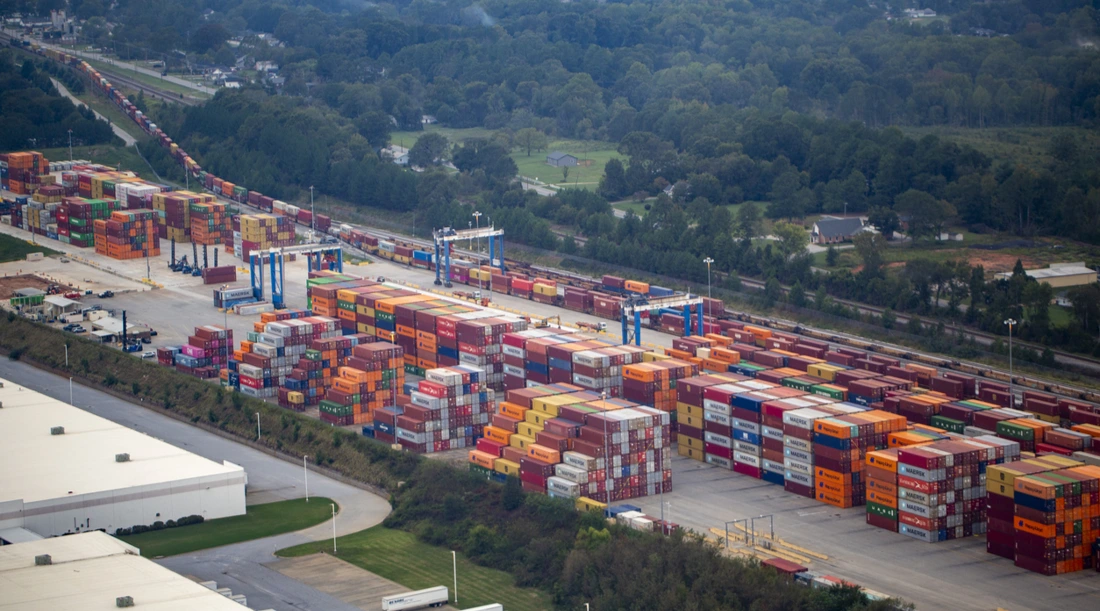
Intermodal freight is a common method of transporting goods using two or more modes of transportation to reach the final destination. These modes can include ships, barges, trains and trucks.3
In North America, intermodal trailers are typically moved long distances overland by rail and shorter distances by trucks.4
Intermodal shipments typically fall into one of two categories: domestic intermodal and international intermodal. In 2024, more than 8.4 million domestic containers and just over 9 million international containers were hauled by train.5
International intermodal shipments typically refer to goods loaded onto 20-foot or 40-foot ISO containers. Those goods often remain in the same container as it travels on ocean carriers, trucks, and trains. The convenience of moving a single container across multiple modes of transportation is a key element of modern, global supply chains.
However, sometimes, the contents of an imported container are transferred to a 53-foot long domestic container at what are known as cross-dock facilities or transload facilities.
Whatever the country of origin, once goods are loaded into a 53-foot container, they are counted as a domestic intermodal shipment.6
Of course, many goods produced in the US are loaded onto these 53-foot containers as well.
In general, this is what the process looks like when goods are being shipped in domestic containers:
- Products are loaded into a container on a truck chassis.
- A truck hauls the container to a nearby intermodal ramp. This truck movement is typically referred to as drayage.
- At the intermodal ramp, the container is lifted from the truck chassis and placed onto a flat car or a well car so it can be shipped by train.
- When the container nears its destination, it comes to rest at another intermodal ramp.
- At this point, the trailer is transferred back to a truck for delivery to a warehouse, distribution center, or retail store.7
One more thing – truck trailers are also a component of intermodal shipping. In 2024, more than 591,000 trailers were hauled by trains. However, that figure is down 16.1% YoY. And trailer volume has been trending downward for 14 consecutive quarters. Since trucking companies have capacity to move goods themselves, they are less dependent on rail networks to supplement their linehaul.8
WHAT ARE THE BENEFITS OF INTERMODAL FREIGHT?
Intermodal freight is considered by many to be a budget-friendly method of transporting goods, especially over medium-to-long distances and when multiple modes of transportation are required.9
These are some of the key benefits of intermodal freight:
Cost Effectiveness: From one continent to another, transporting goods in bulk via container ships is much more affordable than using air cargo. Of course, the trade-off is speed. In a similar fashion, once the goods arrive onshore, transporting them across long distances on railways is more affordable than via trucks. Of course, trains generally move more slowly than trucks.
Congestion Relief: Intermodal transport via rail bypasses highway traffic, construction zones and vehicle accidents.
Sustainability: On average, US freight railroads can move one ton of freight 470 miles per gallon of fuel. While some sustainability initiatives have fallen out of vogue in the US, many international companies are still required to measure their supply chain carbon footprint.10
Well suited for most dry, bulk goods: Most of the world’s products can be stored in containers for weeks at a time. Those goods lend themselves to being transported via multiple modes of transportation over long distances. Of course, perishables, hazardous materials, and oversized cargo may require faster transit times or need specialized handling.
Infrastructure: With nearly 140,000 miles of track available, the US freight rail network is widely considered to be the largest, safest and most cost-effective freight system in the world, according to the U.S. DOT Federal Railroad Administration.11
Reliability: Most maritime carriers, trains, and trucking firms have well established networks and schedules to move goods in a timely manner. Further, when imported goods remain intact within a single container, the risks of damage and cargo theft are mitigated.
WHAT TRENDS ARE DRIVING INTERMODAL SHIPPING GROWTH?
A notable component of the recent intermodal freight volume growth was a 13.9% surge in international container movements via rail. As widely reported last year, US ports were humming with activity as imports surged 13% YoY.12
It seems many transportation managers chose to save money / cut costs by transporting their imports via rail. That provides us with insight on why truckload carriers didn’t see as much benefit from the surge in imports. Last year, less-than-truckload (LTL) carriers faced less headwinds than their truckload counterparts. Perhaps, the LTL carriers were hauling those imports after the railways moved the goods across much of the country.
As reported recently by FreightWaves, the outgoing president and CEO of IANA, Joni Casey, expressed optimism about the future. Casey stated: “The intermodal freight industry demonstrated resilience and adaptability in 2024, overcoming various challenges such as supply chain disruptions, labor shortages, and rising fuel costs. We anticipate continued growth in 2025, driven by sustained economic recovery, evolving consumer demands, and ongoing advancements in technology and infrastructure.”13
The recent IANA report cited several factors contributing to robust intermodal growth in 2024.
Economic rebound: The overall economic recovery, fueled by increased consumer spending, business investment and government stimulus, played a pivotal role in boosting freight demand across various sectors.
Supply chain disruptions: Ongoing disruptions, including port congestion, container shortages and geopolitical tensions, prompted shippers to seek alternative transportation modes and diversify their supply chains, further driving intermodal adoption.
Environmental concerns: Corporate sustainability initiatives helped incentivize the shift toward intermodal freight, with lower carbon emissions and reduced environmental impact compared to trucking.
Technological advancements: Digital platforms for tracking and tracing shipments, automation in intermodal terminals, and data analytics for optimizing operations enhanced the efficiency, visibility and reliability of intermodal freight, making it a more attractive option for shippers.14
WHAT CHALLENGES ARE CREATING HEADWINDS FOR INTERMODAL SHIPPING?
Despite the positive growth in 2024, intermodal freight transportation faces several challenges.
Tariffs: Many companies rely on global and regional supply chains in order to get their products to market. Yet, across a wide range of goods, uncertainty exists regarding when tariffs will be enacted, how high tariffs will be on imports from each country, and for how long tariffs will be in place.
Trade Agreements: North American free-trade agreements such as NAFTA and subsequently, the USMCA, incentivized businesses to integrate their North American operations. Multiple industries may experience cost increases as the Trump administration modifies trade rules by executive fiat. Inevitably, some of those cost increases will be passed on to customers, which may impact the inflation rate.
Driver shortage: IANA said a persistent shortage of truck drivers, particularly for drayage operations, poses a challenge for intermodal efficiency and could lead to increased costs and delays.15
Infrastructure investment: The need for continued investment in infrastructure, including rail networks, intermodal terminals and port facilities, remains crucial to support future growth and accommodate increasing volumes. However, it is unknown how Sean Duffy, the new US Transportation Secretary, will allocate resources in the year ahead. Duffy has expressed support for allowing states to set their own agendas for transportation, which may result in a less cohesive national strategy for upgrading intermodal facilities.16
For these reasons, as well as a number of economic forecasts, the year ahead is expected to bring modest, incremental increases to intermodal freight volumes. Per the IANA, international container loadings are forecast to increase by 0.6%. Domestic container traffic is expected to expand by 3% as intermodal continues to gain share vs. over-the-road competition. Generally, freight flows are expected to return to familiar seasonal patterns as swings in demand, production and inventories fade.17
ABOUT SSI
A FedEx certified freight bill audit & payment provider, SSI serves the needs of supply chain, operations, logistics, shipping and finance executives. We transform the complexity of global freight bill audit and payment into cash savings and supply chain intelligence, providing actionable insights to maximize your profit potential.
- Customizable solution scales with your growing and dynamic business needs.
- Automated freight audit drives savings to the bottom line.
- Over 30 years of experience in transacting international payments for our customers.
- Fintech platform allows you to pay invoices in 150+ currencies, at favorable exchange rates.
- Cutting-edge data visualization facilitates analysis.
- Actionable business intelligence supports supply chain optimization and operational efficiencies.
Want to learn more? Our team is eager to help you save money. Contact SSI.
Footnotes:
1. Jeff Berman, “Intermodal volumes finish 2024 with solid growth, reports IANA”. January 30, 2025, as published by Logistics Management.
2, 5, 8, 15, 17. IANA, “2024 Year-End Intermodal Summary”. Intermodal Quarterly PDF, as published by IANA and posted by Railway Age.
3, 9. Maersk transportation and freight post, “Intermodal transportation: What is it and how does it work?”. September 6, 2024, as published by Maersk.
4. Feature Stories, Knowledge Center, “What Is Intermodal Transportation? History, Benefits, Examples”. October, 2022, as published by Inbound Logistics.
6, 7, 10. Phil Yeager, “What Is Intermodal Shipping…and Why Should Shippers Care?”. August 4, 2020, as published by Union Pacific.
11. Federal Railroad Administration, “Freight Rail Overview”. Undated, as published by the U.S. Department of Transportation Federal Railroad Administration.
12, 13, 14. Stuart Chirls, “IANA: Intermodal saw turnaround in 2024”. January 31, 2025, as published by FreightWaves.
16. Eugene Mulero, “DOT Secretary Duffy Outlines Highway Bill Priorities“. February 11, 2025, as published by Transport Topics.
SSI blog post entitled: Intermodal Freight Update – Tracking Volume Growth.